Why Your Office “Rank Checks” are Lying to You: The Proximity Trap
Section 1: The “Office Trap” – Why Your #1 Rank is an Illusion
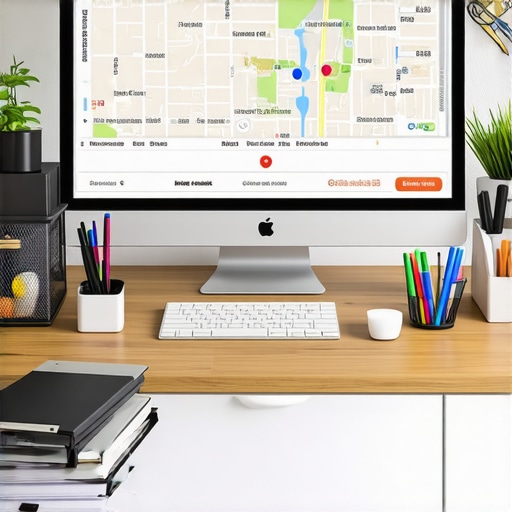
It is a scene I witness weekly as a consultant. A business owner, perhaps a personal injury lawyer or a residential plumber in Laredo, sits down at their desk, opens a fresh incognito window, and types their primary service into Google. They see their business sitting pretty at the #1 spot in the local map pack. They lean back, satisfied that their google business profile seo is firing on all cylinders. They assume that because they see themselves at the top, every potential customer in the city sees the same thing.
I hate to be the one to break the news, but that #1 ranking is almost certainly a lie. You have fallen into the “Office Trap.”
When you perform a search from your office chair, Google is using your precise GPS coordinates (on mobile) or your IP address (on desktop) to determine your location. Because you are standing exactly where your business is located, your “Distance” score is mathematically perfect. Google’s algorithm is designed to provide the most convenient result to the user. In this hyper-local context, the most convenient result is the one right under your feet. This is why your Laredo shop’s map pin stops appearing three blocks away even if you look like a superstar from your own desk.
The reality is that “rank” in Google Maps is not a static number. It is a fluid, living entity that changes every time a user moves fifty feet in any direction. If you are relying on manual searches from your own place of business to gauge your success, you aren’t just getting an incomplete picture – you are getting a fundamentally “fake” result that doesn’t represent your actual market reach.
Section 2: The Science of Proximity – How Google Maps Actually Works
To understand why your office searches are misleading, we have to look under the hood of the local algorithm. Google officially confirms that local rankings are determined by three primary pillars: Relevance, Distance, and Prominence.
- Relevance: How well a local business profile matches what someone is searching for. This is where your categories and on-page SEO come into play.
- Distance: How far each potential search result is from the location term used in a search. If the user doesn’t specify a location (e.g., just “dentist”), Google calculates distance based on what it knows about the user’s location.
- Prominence: How well-known a business is. This is based on information that Google has about a business from across the web (links, articles, directories) and your review count/score.
The “Proximity Paradox,” a term popularized by Search Engine Land, explains the inherent bias Google has toward the user’s current location. In a dense market, the “Distance” factor often outweighs “Prominence.” This means a mediocre business that is 200 feet away from the searcher will often outrank a world-class business that is 2 miles away. When you check your own rank at your office, you are essentially “cheating” the Distance factor.
To see how these factors are actually weighed across your entire city, you cannot rely on a browser. You need a professional google maps ranking service that can spoof GPS coordinates and query the API from multiple points on a grid. This is the only way to visualize the “Proximity Paradox” in action. You might find that while you are #1 at your office, you drop to #14 once the searcher crosses the highway. This is a critical distinction because being the closest shop in Laredo doesn’t guarantee top map rankings once you move outside your immediate neighborhood.
Section 3: Why Your Rankings “Ghost” You After 5 PM
Have you ever noticed that your phone stops ringing the moment you head home for the day? It’s not just because people stop searching; it’s often because your profile has literally vanished from the map pack. This “ghosting” effect is one of the most common reasons business owners ask, “why is my google business profile not ranking?”
Google’s primary goal is user satisfaction. If a user searches for “emergency plumber” at 8:00 PM, and your profile says you closed at 5:00 PM, Google is highly unlikely to show you in the top three. Why? Because showing a closed business to someone with an immediate need is a poor user experience. The “Open Now” filter is often applied by default or subconsciously by the algorithm’s intent-matching engine.
Furthermore, google map pack ranking factors are highly sensitive to real-time data. Sentiment on platforms like Reddit suggests that service-based businesses (SABs) suffer the most from this volatility. If you haven’t optimized your hours or utilized “Special Hours” for holidays, you are essentially telling Google to stop showing your business to potential customers during those windows. Your “rank” is not just about where you are; it’s about *when* you are. If you aren’t using a google maps rank tracker that allows for scheduled checks at different times of the day, you are missing the “after-hours” data that could be costing you thousands in lost leads.
Section 4: The 2026 Proximity Shift – AI and Hyper-Localization
As we move through 2026, the landscape of google business profile seo is shifting yet again. We are currently seeing the evolution of what some experts call the “Proximity Hawk” update – an AI-driven refinement of the local algorithm that makes the ranking radius even tighter than it was two years ago.
Google’s Search Generative Experience (SGE) and AI-driven filters are now capable of real-time inventory syncing and deep sentiment analysis. In 2026, proximity isn’t just about miles; it’s about “micro-convenience.” If AI predicts a user is looking for a quick “in-and-out” service, it will shrink the map pack radius to a few blocks. Conversely, for high-ticket services like “estate planning attorney,” the radius may expand. Many local owners fail the 2026 mobile trust test because their profiles aren’t optimized for these hyper-localized AI filters.
We are also seeing “AI-only” search transitions where the traditional “10-blue links” are replaced by a map and an AI summary. In this environment, if you aren’t in the top 3, you don’t exist. This is why many businesses see their traffic plateau; they are stuck in a 2023 mindset while the algorithm has moved on. If you haven’t looked at your data lately, you might find Laredo SEO audit holes in 2026 that are allowing competitors from further away to “poach” your local traffic through better prominence signals.
Section 5: How to See the “Real” Map
If manual searching is useless, how do you actually measure success? The answer lies in Geogrid tracking. A Geogrid is a visual map that places “pins” across a specific radius (e.g., a 5-mile circle around your office). The tool then performs a search at every single one of those pins simultaneously.
The result is a heatmap of your rankings. You might see a “1” at your office, but “8s”, “12s”, and “20s” just a mile away. This is the truth that your office rank checks are hiding from you. To get this level of insight, you must invest in high-quality local seo software. These tools allow you to see exactly where your “ranking bubble” ends.
Using a google maps rank tracker is the only way to build a real google business profile seo strategy. Once you see that you drop off in the North side of Laredo but remain strong in the South, you can tailor your local content and backlink strategy to target those specific “weak” zones. This is one of the 7 local SEO audits Laredo stores use to beat national chains that have massive budgets but lack local precision. Don’t fly blind – use the data to see the real map.
Section 6: Strategies to “Break the Bubble” and Rank Further Away
The goal of any rank higher on google maps campaign is to expand your ranking radius. Since you cannot change your physical distance from the searcher, you must over-compensate with Relevance and Prominence. This is known as “breaking the proximity bubble.”
- Hyper-Local Content: Stop writing generic blog posts. Write about specific Laredo neighborhoods, local events, or traffic issues near your shop. This signals to Google that your “Relevance” extends beyond your front door.
- Local Link Building: A link from a Laredo high school or a local news outlet is worth ten links from a national blog. These links build your “Prominence” in a specific geographic cluster.
- Review Velocity and Diversity: Don’t just get 5-star reviews; get reviews that mention specific services and locations. “Best plumber in North Laredo” is a powerful signal.
- Advanced Schema: Use LocalBusiness Schema markup to explicitly tell Google your service area and coordinates.
By focusing on google business profile optimization that emphasizes authority, you can force Google to show your business to searchers who are 5, 10, or even 15 miles away, effectively defeating the proximity bias of competitors who are closer but less prominent.
Section 7: Conclusion & Final Call to Action
Stop falling for the “Proximity Trap.” Your office rank checks are giving you a false sense of security while your competitors are eating your lunch just three blocks away. In the hyper-competitive world of 2026 local search, guessing is a recipe for failure. You need to see the real data, understand your true ranking radius, and take aggressive steps to expand it.
Audit your profile today. Use a professional google business profile audit tool to visualize your reach and identify the gaps in your local strategy. The “real” map is waiting for you – it’s time you started winning on it.